
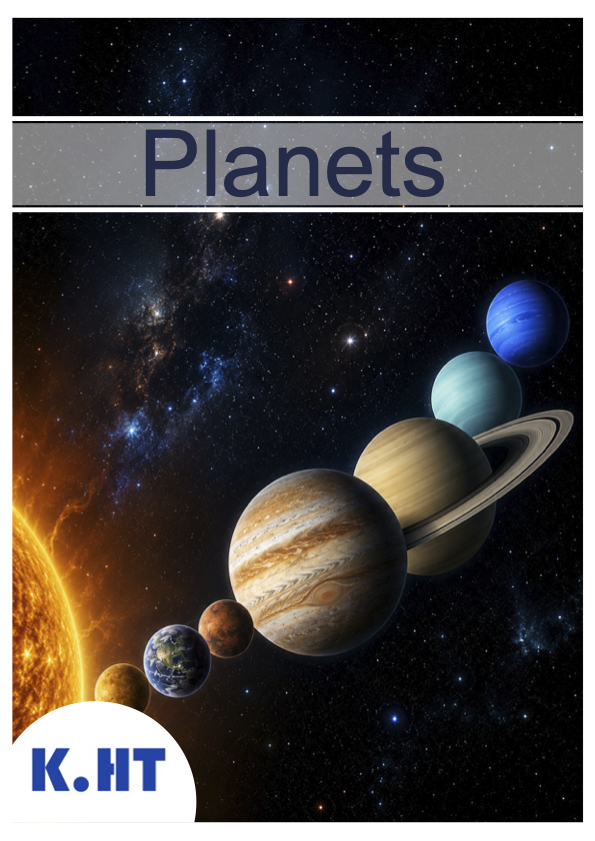
What if we could look at our cosmic home from a completely new perspective?
At first glance, our solar system seems familiar: the Sun, Earth, the Moon, and the planets we have known since childhood. Yet behind this apparent familiarity lies a world full of extreme conditions, immense forces, fascinating landscapes, and unanswered mysteries.
“Planets – A Journey Through Our Solar System” takes you on an exciting journey through this extraordinary cosmic neighborhood.
From Mercury, the planet closest to the Sun, to distant Neptune, the eight planets of our solar system are presented in an engaging and accessible way. The book is not simply a collection of numbers and distances. It explains how these worlds are structured, what makes each of them special, and how they have changed over billions of years.
Eight Planets – Eight Completely Different Worlds
Mercury is a small, crater-covered world with extreme temperature differences. Venus, by contrast, is surrounded by a dense carbon-dioxide atmosphere and experiences a powerful greenhouse effect. Earth offers liquid water, a protective atmosphere, and known forms of life, making it unique among the worlds we have studied.
Mars fascinates us with its red surface, enormous volcanoes, and clear evidence of a wetter past. On Jupiter, the largest planet, we encounter gigantic storms, a powerful magnetic field, and an impressive system of moons.
Saturn captivates us with its famous rings, while its moon Titan has rivers and lakes of liquid methane, creating a landscape unlike anything on Earth. Uranus surprises us with its unusual tilt and extraordinarily long seasons. Neptune, the most distant planet, impresses with powerful winds and a dynamic atmosphere.
Every planet tells a different story.
How Do Planets Form?
But how do such worlds come into existence?
The book looks back at the formation of our solar system approximately 4.6 billion years ago. From a gigantic cloud of gas and dust, the young Sun and a rotating disk of material first emerged. Tiny dust particles gradually joined together, forming larger bodies and eventually planets.
The book explains in an accessible way why the inner planets are composed mainly of rock and metal, while the enormous gas and ice giants formed farther from the Sun.
The story of our solar system thus becomes a fascinating journey through the fundamental processes of planet formation.
Fascinating Moons and Mysterious Worlds
A planet is often only part of a much larger system.
Jupiter and Saturn have numerous moons, some of which have become spectacular research targets in their own right. Io, for example, is the most volcanically active known body in the solar system. Europa probably has a deep ocean beneath its icy crust.
Saturn’s moon Titan is also one of the most extraordinary worlds we know. Its dense atmosphere and methane cycle resemble Earth’s water cycle in certain ways, even though the conditions there are completely different.
The book shows why these moons are so important to modern planetary science and what questions they pose to researchers.
From Pluto to Comets
The journey does not end with the eight planets.
Dwarf planets, asteroids, and comets are also part of the story of our solar system. Pluto, once known as the ninth planet, has an amazingly varied surface. Asteroids preserve material from the early solar system and can therefore be regarded as cosmic time capsules.
Comets, meanwhile, reveal how icy bodies change when they approach the Sun. Their tails are among the most spectacular phenomena in our solar system.
The book explores why these smaller worlds are scientifically important and what they can tell us about the origins of our cosmic home.
The Search for Life
One of modern science’s most exciting questions is: Are we alone?
So far, Earth is the only known place in the universe where life has been confirmed. Yet Mars, Europa, Enceladus, and other worlds are the subject of intensive research.
Where water exists, a potential habitat may theoretically exist as well. Spacecraft and rovers therefore search for traces of ancient environments and investigate the chemical composition of distant worlds.
The discovery of planets beyond our solar system opens up entirely new possibilities. Perhaps somewhere there are conditions similar to those found on Earth.
Science Explained Clearly
This book is intended for anyone who wants to learn more about planets and our cosmic surroundings.
Complex astronomical concepts are explained clearly and accessibly while keeping their scientific foundations in view. The chapters take readers step by step from the formation of the solar system and the individual planets to modern space exploration and the search for extraterrestrial life.
The book explores both fundamental questions and fascinating details:
Why is Venus hotter than Mercury?
How can an ocean exist beneath the ice of a distant moon?
Why does Uranus practically lie on its side?
How do the enormous storms on Jupiter and Neptune form?
Why does Saturn have rings?
And what can asteroids and comets tell us about the formation of our cosmic home?
A Book to Inspire Wonder and Discovery
“Planets – A Journey Through Our Solar System” combines astronomical knowledge with the fascination of the great questions of the universe.
It invites readers to look at familiar celestial bodies from a new perspective while discovering the enormous scale of space.
Anyone interested in astronomy, space exploration, natural science, or simply in the question of what lies beyond our world will find a compact and varied introduction to the planets.
Because our solar system is far more than a collection of spheres orbiting the Sun.
It is a dynamic system of fire and ice, rock and gas, volcanoes and oceans, storms and silent landscapes – shaped over billions of years and still full of unsolved mysteries.
Join us on a journey from the Sun to the outer reaches of our solar system – and discover the fascinating worlds that make up our cosmic home.

Reviews
There are no reviews yet.