

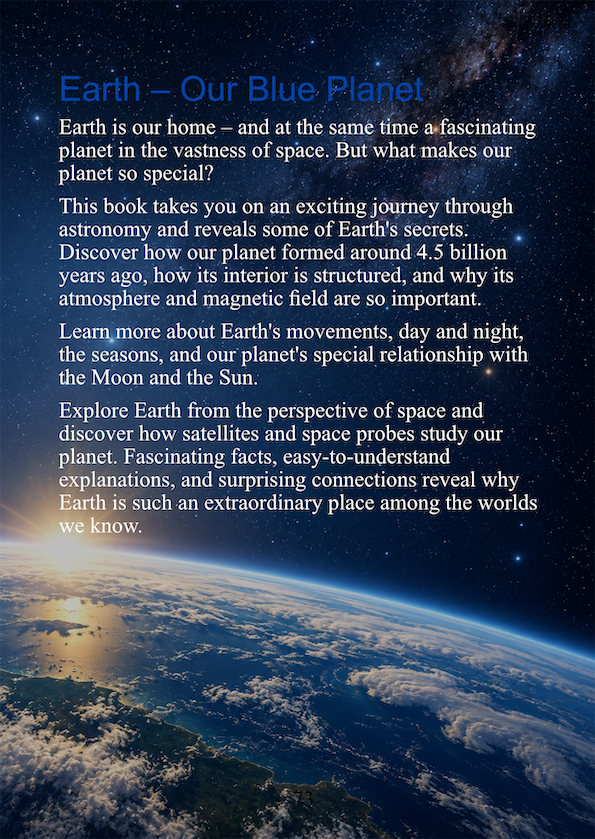
Earth is our home – and yet, from an astronomical perspective, our planet is far more extraordinary than we might first imagine. This book invites readers to look at Earth not only as a place where we live, but as a fascinating celestial body travelling through the vastness of space.
From the formation of the planet about 4.54 billion years ago to its present-day appearance, the journey explores the most important aspects of modern astronomy and planetary science. It addresses questions that naturally inspire curiosity: How did Earth form? What lies deep beneath our feet? Why does our planet have an atmosphere and a magnetic field? And why was life able to develop here?
The accessible texts combine scientific information with clear explanations. They reveal that Earth is much more than the familiar landscape beneath our feet.
Earth from a Cosmic Perspective
The first part of the book places Earth within its larger cosmic context. It is the third planet from the Sun and part of a solar system that itself occupies only a tiny region of the Milky Way. And the Milky Way is only one of countless galaxies.
This perspective changes the way we see our planet. Earth appears small and insignificant on a cosmic scale, yet it is also the only place we know of where life has been clearly detected.
The book explains which properties distinguish Earth from other planets. Liquid water, a protective atmosphere, a magnetic field and a suitable distance from the Sun have combined to create conditions in which a diverse biosphere could develop.
Earth therefore becomes an important reference point in the search for life on other worlds.
How Earth Was Formed
A dedicated chapter explores the spectacular origin of our planet. Billions of years ago, Earth was not the finished blue world we know today. Instead, it formed from dust, rock and other material within the young solar system.
Through countless collisions, increasingly large bodies developed. The young Earth became extremely hot, heated by impacts and internal processes. Heavy elements sank toward the center, while lighter materials formed the outer layers.
The book also explores the origin of the Moon. A giant collision early in Earth’s history may have caused material to be thrown into space, eventually forming our natural satellite.
Readers discover how a vast collection of cosmic material gradually became the planet we know today.
A Planet with a Dynamic Interior
Earth looks calm from the outside. Deep inside, however, enormous temperatures and pressures prevail. The book takes readers on a journey through the crust, mantle and core.
Earth’s crust forms only a relatively thin outer layer. Beneath it lies the enormous mantle, where rock moves extremely slowly over geological timescales. At the center is the metallic core, consisting of a liquid outer core and a solid inner core.
These processes are far from insignificant. They are connected with the movement of tectonic plates, the formation of mountains and volcanoes, and the magnetic field of our planet.
This makes it clear why Earth is a dynamic world whose surface is constantly changing.
Atmosphere, Weather and Oceans
Earth possesses something that many other known worlds do not: a complex atmosphere and enormous quantities of liquid water at the surface.
The book explains the structure of the atmosphere and shows why it is essential for life. Readers learn how clouds, rain, wind and thunderstorms form and what role the Sun plays in these processes.
Another focus is the oceans. They cover about 71 percent of Earth’s surface and store vast amounts of heat. Ocean currents transport this heat around the globe and influence the climate.
The water cycle is also explained clearly. Evaporation, cloud formation, precipitation and runoff connect the atmosphere, land and oceans in a vast natural cycle.
Earth Is Constantly Moving
Day and night, the seasons and the apparent movement of the Sun across the sky are direct consequences of our planet’s movements.
The book explains Earth’s rotation on its axis as well as its orbit around the Sun. It makes particularly clear why the tilt of Earth’s axis causes the seasons.
The Moon also plays an important role. Its gravity influences the tides, and its presence is connected with the long-term stability of Earth’s axial tilt.
Solar and lunar eclipses demonstrate especially impressively how precisely the movements of the Sun, Earth and Moon are connected. These celestial events are explained clearly and placed within the broader context of celestial mechanics.
The View from Space
One of the most fascinating perspectives on Earth is the view from space. Only the space age made it possible to see our planet as a whole.
From a great distance, Earth appears as a blue-and-white sphere with luminous clouds, dark oceans and a thin atmosphere. Political borders disappear. Instead, we see that all human beings share the same small planet.
The book shows how satellites and spacecraft help us study Earth today. They observe weather, oceans, ice sheets, land surfaces and the atmosphere.
Space exploration is therefore not only about studying the universe. It is also one of the most important tools for understanding our own planet.
Earth and Its Cosmic Neighbors
How special is Earth really? One way to answer this question is to compare it with other planets.
Venus resembles Earth in size and structure, but has an extremely dense atmosphere and a very hot surface. Mars is smaller, colder and has only a thin atmosphere today. The gas giants and ice giants of the outer solar system are fundamentally different from our rocky planet.
These comparisons make Earth’s properties easier to recognize. Why are there vast oceans here? Why does Earth have such a diverse atmosphere? And why was life able to develop?
The book does not offer simple answers to every great question, but it shows which connections modern planetary science has already uncovered.
Life on a Small Blue Planet
Perhaps the most fascinating part of Earth’s story is the origin and development of life.
Our planet contains an extraordinary diversity of living organisms. Life exists in oceans, deserts, forests, polar regions and even extreme environments. Plants, animals, fungi and microorganisms form a complex network of interconnected habitats.
The book considers the biosphere from an astronomical perspective. The question of why life is possible on Earth is closely connected with the search for life beyond our planet.
Water, energy, suitable temperatures and a relatively stable environment are important parts of this story. Earth therefore serves as a reference when scientists investigate Mars, icy moons and distant planets.
A Changing Planet
Earth is not a static celestial body. Continents move, mountains form and are eroded, volcanoes reshape the surface, and oceans change over geological time.
The climate has also changed repeatedly. Scientists therefore study not only the present but also ice cores, rocks, sediments and other archives of the past.
The book explains how natural forces such as earthquakes, volcanic eruptions, storms and tsunamis arise. At the same time, it shows that change is a normal part of Earth’s long history.
A look into the future completes the story. Earth will continue to change – and eventually the evolution of the Sun will fundamentally alter conditions on our planet.
Scientifically Sound and Easy to Understand
This book is aimed at everyone who wants to learn more about our planet without having to work through complicated specialist literature.
The subjects are explained clearly without reducing them to mere keywords. Astronomical connections, physical principles and geological processes are brought together.
Numerous concrete figures and comparisons help readers understand scale: How large is Earth? How far is it from the Sun? How fast does it travel through space? How far away is the Moon?
The result is an informative and accessible overview of our home planet – ideal for reading, reference and discovery.
An Invitation to Wonder
Looking at Earth from the perspective of astronomy means seeing familiar things with new eyes. Sunrise becomes the result of Earth’s rotation. The seasons become an interaction between orbital motion and axial tilt. The Moon becomes a dynamic companion to our planet, and the atmosphere becomes a remarkably thin protective layer surrounded by space.
This book shows how many fascinating stories are hidden behind seemingly ordinary things.
It is suitable for curious readers, families, young people and anyone interested in astronomy and our place in the universe.
After reading this book, you may look at Earth differently: not simply as the place where we live, but as a fascinating planet travelling through space.


Reviews
There are no reviews yet.