
Coming soon …
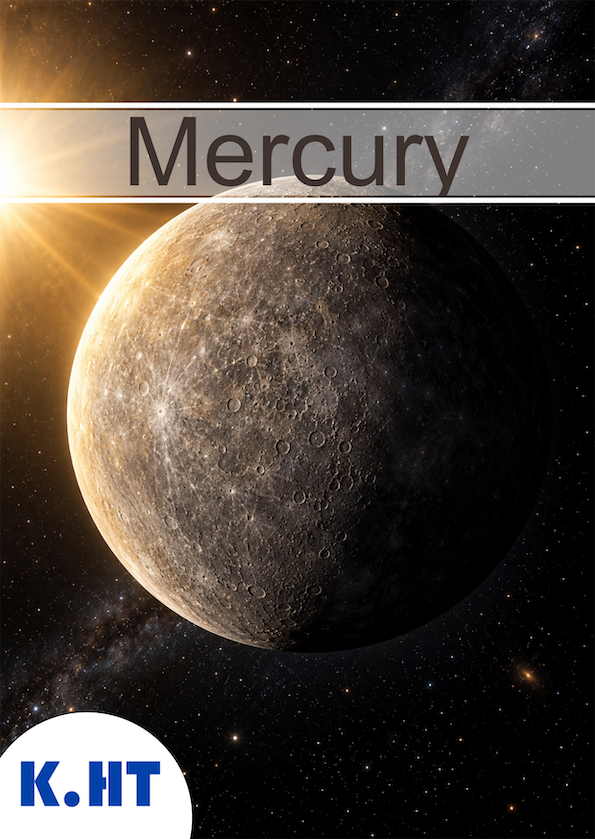
What do we really know about Mercury? The smallest planet in our solar system may look like an unremarkable, heavily cratered ball of rock. Yet beneath its gray surface lies a world of extremes, surprising discoveries, and unanswered questions. This book invites readers to discover Mercury from a new perspective and explore the fascinating secrets of our innermost planetary neighbor.
Closest to the Sun
Mercury is closer to the Sun than any other planet. As a result, it is exposed to enormous radiation and extreme temperatures. On its sunlit surface, temperatures can become hot enough to heat metals dramatically. At the same time, the long night brings bitter cold. This extraordinary contrast makes Mercury one of the most extreme environments in the solar system.
A Year Shorter Than You Might Expect
But temperature differences are only part of its story. Mercury has an unusual motion around the Sun. Its year lasts only about 88 Earth days, while a solar day lasts about 176 Earth days. How can a day last longer than a year? And why does Mercury travel around the Sun faster than any other planet? This book explains these unusual movements in a clear and accessible way.
A Landscape Shaped by Cosmic Forces
The surface of Mercury also tells an impressive story. Vast impact craters bear witness to an era when the young solar system was struck by countless cosmic bodies. Huge basins, volcanic plains, long cliffs, and mysterious hollows show that Mercury is far from being a boring rocky world. The enormous Caloris Basin, in particular, is one of the planet’s most spectacular landscapes.
The Mystery Beneath the Surface
Another major mystery lies beneath the surface. Compared with its size, Mercury has an exceptionally large metallic core. Why is this core so enormous? What processes led to this unusual composition? The book explores several scientific explanations and shows why Mercury is so important for understanding how rocky planets form and evolve.
A Planet with a Magnetic Field
It is also surprising that Mercury has its own magnetic field. For a small rocky planet, this is remarkable. Studying this magnetic field provides important clues about processes deep inside the planet. At the same time, Mercury is engaged in an intense interaction with the solar wind, a continuous stream of charged particles flowing outward from the Sun.
Ice in the Shadow
And then there is water. Anyone who thinks only of scorching heat when imagining Mercury may be surprised: water ice can survive for very long periods inside permanently shadowed craters near the planet’s poles. How is this possible? Where did the water come from? And why can it survive despite Mercury’s proximity to the Sun? This remarkable feature demonstrates how surprising nature can be, even under extreme conditions.
Exploring Mercury from Space
The book also looks at the most important space missions to Mercury. Mariner 10 gave humanity its first close-up views of the planet. Decades later, MESSENGER orbited Mercury and provided a wealth of new information about its surface, interior, magnetic field, and water ice. BepiColombo opened another major chapter in Mercury exploration. Its mission is designed to investigate many outstanding questions in even greater detail and expand our knowledge of this small planet.
The Challenge of Reaching Mercury
The journey to Mercury is fascinating in its own right. Although the planet appears relatively close to Earth, sending a spacecraft there and placing it into orbit is far from simple. The Sun’s powerful gravity makes complex trajectories and precise maneuvers necessary. Mercury exploration therefore brings astronomy, physics, and space engineering together in a particularly exciting way.
Clearly Explained and Accessible
This book is intended for everyone interested in planets, space exploration, and the mysteries of the universe. The text is written in a clear and accessible style, explaining scientific ideas without unnecessary technical language. It presents not only established facts but also questions for which researchers have not yet found definitive answers.
Questions That Reach Beyond Mercury
Mercury is an excellent example of how a small world can raise enormous questions. How do planets form? Why do they become so different from one another? What roles do impacts, volcanism, and cooling play? How can water and other volatile materials survive under extreme conditions? And what can the structure of a small planet tell us about the formation of our entire solar system?
Discover a World of Extremes
After reading this book, you will no longer see Mercury simply as a tiny point of light in the morning or evening sky. Instead, you will discover a dynamic, extreme, and surprisingly diverse world. A world of craters and mountains, heat and ice, solar wind and magnetic fields – and a world full of mysteries that will continue to challenge future generations of scientists.
A Journey Through Billions of Years
Join Mercury on its journey through billions of years of cosmic history. Discover its most spectacular landscapes, most remarkable properties, and most important space missions. Meet a planet that shows us just how diverse our solar system really is.
Mercury is small. Its mysteries are not.

Reviews
There are no reviews yet.