
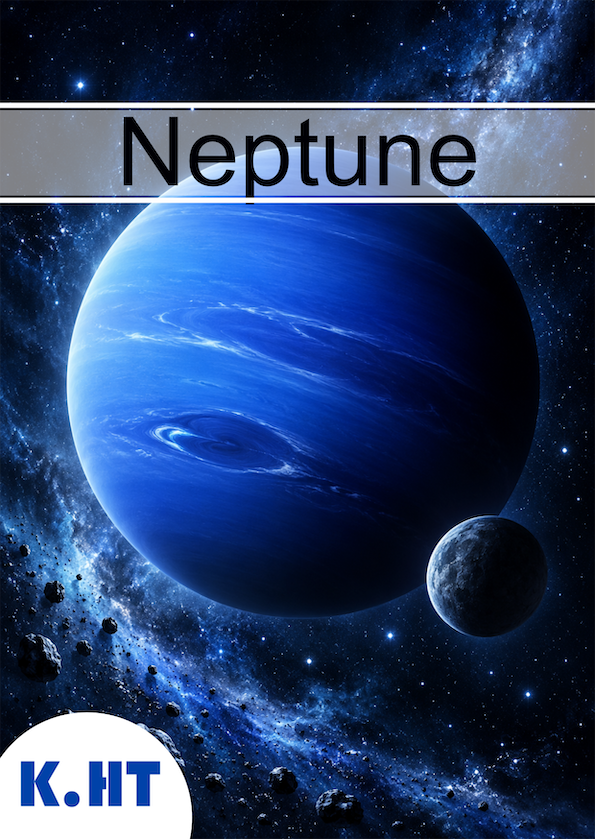
What does a world look like when it lies some 4.5 billion kilometres from the Sun? Why does Neptune glow in a mysterious blue, even though so little sunlight reaches it? And how can winds that rank among the fastest in the entire solar system arise in its icy atmosphere? This compact non-fiction book takes you on an exciting journey of discovery to a planet that still holds many mysteries, despite modern telescopes. Clear, informative and scientifically grounded, it presents the most important findings about the eighth planet of our solar system.
A Distant Ice Giant Full of Contrasts
Neptune is almost four times as wide as Earth and has roughly seventeen times its mass. Yet it is fundamentally different from our home planet: there is no solid surface on which one could stand. Instead, its vast atmospheric and interior layers extend into regions of extreme pressure and unusual states of matter. The book explains why Neptune is classified as an ice giant, what roles hydrogen, helium, methane and heavier substances play, and why the word “ice” does not simply mean a world that is frozen throughout.
The Discovery: A Triumph of Mathematics
The story of Neptune begins with a remarkable scientific achievement. Irregularities in the orbit of Uranus led astronomers to suspect that another planet must exist. Mathematical calculations were used to determine its possible position. In 1846, astronomers at the Berlin Observatory finally succeeded in observing it deliberately. Discover the contributions of Urbain Le Verrier, John Couch Adams, Johann Gottfried Galle and Heinrich d’Arrest to this discovery. The book vividly shows how observations, physical laws and careful calculations brought a new world into view in the night sky.
Blue Clouds, Racing Winds and Enormous Storms
Neptune’s atmosphere is particularly impressive. Methane affects the colour of reflected sunlight and contributes to the planet’s bluish appearance. Bright clouds, dark vortices and enormous storm systems also form there. Wind speeds well above a thousand kilometres per hour make Neptune a planet of extraordinary weather. The book describes the Great Dark Spot, observations of other vortices, and the question of why a planet so far away can have such an active atmosphere. Its internal heat and rapid rotation are also explained in accessible terms.
A Short Day and an Almost Endless Year
A day on Neptune lasts only about sixteen hours. By contrast, the planet takes almost 165 Earth years to complete one orbit around the Sun. Its tilted axis of rotation produces seasons that can each last more than forty Earth years. These astonishing timescales illustrate just how different the planets of our solar system are. The book also explains why the enormous distance from the Sun affects not only temperatures but also communication with space probes and the planning of future missions.
Rings and Moons: Discovering an Entire System
Neptune has dark, difficult-to-detect rings and a diverse family of natural satellites. Alongside the known rings, the book introduces the unusual ring arcs, where particles are concentrated in particular areas. Special attention is given to Triton, Neptune’s largest moon. It orbits the planet in the opposite direction to Neptune’s rotation, has an icy surface and shows evidence of active eruptions. Nereid, Proteus and smaller inner moons are also covered. Together, they reveal a complex system whose evolution is closely linked to gravitational interactions.
Voyager 2 and the Exploration of a Distant World
In 1989, the Voyager 2 spacecraft flew past Neptune and provided the only close-up observations of the planet made to date. Its images revealed surprisingly dynamic clouds, dark storms, rings and Triton’s fascinating surface. The book retraces the spacecraft’s long journey and explains what its instruments enabled scientists to learn. It also describes how Hubble and the James Webb Space Telescope study Neptune today, and which questions a future mission might answer. This history of exploration combines pioneering technological achievements with unresolved scientific challenges.
Knowledge Presented Clearly and Concisely
This pocket-sized book is intended for anyone interested in astronomy, planets and space exploration. Its clearly organised chapters offer an easy introduction and are equally suitable for looking up specific topics. Important connections are deliberately revisited in different places so that individual subjects can also be understood independently. Comparisons with Earth, Uranus and the gas giants help put sizes, distances and characteristics into perspective. Throughout, the emphasis is on a factual presentation that distinguishes established observations from questions that remain open to research.
For Curious Readers, Learners and Space Enthusiasts
Whether as a first introduction to the outer planets, supplementary reading for school or leisure, or a handy gift for astronomy enthusiasts, this book offers a varied overview of Neptune. It shows not only what we already know but also how much remains to be discovered. Anyone who wants to understand why Neptune plays a key role in the outer solar system will find a compact and accessible companion here. Discover a distant ice giant whose storms, moons and mysteries continue to fascinate researchers today. The journey leads from the fundamentals of our solar system through spectacular weather phenomena to the limits of current research. Each stage offers a new perspective on the diversity of planetary worlds and the importance of patient scientific observation.

Reviews
There are no reviews yet.