
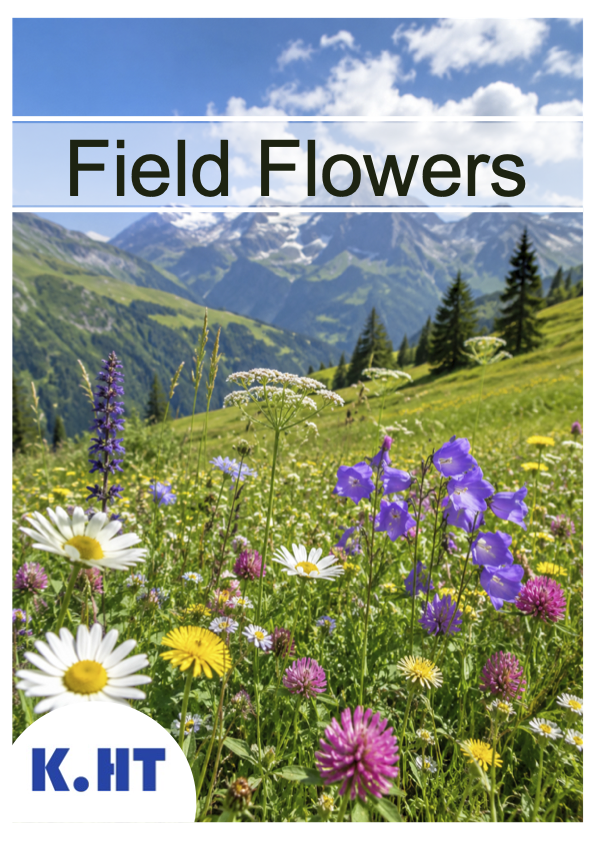
Flowering meadows are among the most beautiful and characteristic landscapes of Switzerland. In spring and summer, they transform into colourful carpets of white, yellow, pink, red, blue and violet, with wildflowers growing among grasses and herbs. Yet anyone who takes a closer look will discover that a meadow is much more than a collection of pretty flowers. It is a living ecosystem in which plants, insects, birds, small animals and countless soil organisms are closely connected.
“Wildflowers of Switzerland” invites readers to explore this fascinating natural world. The book is ideal for nature lovers, walkers, hikers, families and anyone interested in discovering the rich plant life of Switzerland. Its accessible explanations make it easy to learn about wildflowers without requiring extensive botanical knowledge.
A Journey Through Switzerland’s Meadows
Switzerland offers an extraordinary variety of landscapes. The Jura, the Swiss Plateau, the Pre-Alps, the Alps and the southern regions of the country differ in climate, altitude, geology and soil conditions.
These differences are reflected in the vegetation.
A dry, sunny meadow may contain completely different plants from a damp meadow beside a stream. The amount of nutrients in the soil also plays an important role. Nutrient-poor meadows can support a remarkable variety of flowering plants, while heavily fertilised areas are often dominated by a smaller number of particularly competitive species.
This book explains these differences in an accessible way and helps readers understand why certain plants grow in particular places.
Familiar Flowers Rediscovered
Many meadow flowers are so common that we hardly notice them anymore. Daisies, dandelions, oxeye daisies, red clover and white clover are familiar sights throughout much of Switzerland.
Yet every plant has its own fascinating story.
The dandelion, for example, develops its characteristic spherical seed head after flowering. Its seeds are equipped with delicate structures that allow the wind to carry them away. Clover belongs to the legume family and forms a relationship with soil bacteria that can fix atmospheric nitrogen. The oxeye daisy provides a valuable source of food for various visiting insects.
Learning to recognise these familiar plants also reveals the natural processes taking place all around us.
Discover a Rich Variety of Field Flowers
The book introduces readers to a selection of characteristic Swiss meadow plants, including the common daisy, dandelion, oxeye daisy, red clover, white clover, brown knapweed, spreading bellflower, field scabious, meadow sage, meadow buttercup, meadow salsify and many other species.
Each plant offers an opportunity to explore distinctive features such as flower shapes, leaves, flowering periods, preferred habitats and relationships with other organisms.
The aim is not simply to memorise botanical names. Above all, the book encourages readers to learn how to observe nature more closely.
Meadows Through the Seasons
A meadow never looks exactly the same throughout the year.
In spring, the first flowers appear while the vegetation remains relatively short. Sunlight can easily reach plants growing close to the ground.
As summer approaches, growth accelerates. Grasses become taller, and numerous flowering plants open their blooms. At the height of summer, a meadow can become a spectacular display of colours and shapes.
Later, many plants begin producing seeds. Flowers fade, but life continues. In autumn, dried flower heads and fruits become more prominent, while plants prepare for the colder months.
Even in winter, a meadow is not truly lifeless. Roots, seeds and low-growing leaf rosettes remain part of the ecosystem.
A World Full of Insects
Meadow flowers are closely connected to the lives of insects.
Wild bees, bumblebees, butterflies, hoverflies, beetles and many other insects visit flowers in search of nectar and pollen. During these visits, they often contribute to pollination.
However, a biodiverse meadow offers much more than flowers. Stems, leaves, soil, stones, shrubs and areas of uncut vegetation can provide food, shelter and breeding sites for numerous animals.
A flowering meadow should therefore be understood as a complete ecosystem, rather than simply a colourful landscape.
Nutrient-Poor and Dry Meadows
An important part of the book focuses on nutrient-poor and dry meadows.
The term “nutrient-poor” does not mean that the soil is bad. It refers primarily to the limited availability of nutrients. Under these conditions, fast-growing species are less dominant, allowing many different plants to coexist.
The result can be an exceptionally varied and colourful plant community.
Dry grasslands and pastures are among Switzerland’s particularly species-rich habitats. They support specialised plants and provide important resources for many insects.
Their conservation depends on local environmental conditions and appropriate land management.
Wet Meadows and Mountain Meadows
Wet meadows have their own distinctive characteristics. Here, water availability and soil moisture strongly influence which plants can grow.
Depending on local conditions, species such as cuckooflower, meadowsweet and various sedges may be found in these habitats.
Mountain meadows are shaped by different environmental factors. As altitude increases, the growing season becomes shorter, temperatures fall and snow may remain on the ground for many months.
Mountain meadows and alpine pastures consequently have their own seasonal rhythms and characteristic plant communities.
Learn to Identify Wildflowers
The book also offers practical guidance for anyone beginning to identify wild plants.
Flower colour is a useful first clue, but it is rarely sufficient on its own. Leaf shape, stems, flower structures, fruits, plant height and habitat can all provide important information.
A photograph showing the entire plant, together with close-ups of its leaves and flowers, can be particularly useful when identifying a species later.
With a little practice, an ordinary walk can become a fascinating botanical adventure.
Indicator Plants: What Flowers Tell Us About the Soil
Some plants can provide clues about the conditions in which they grow. Their presence may indicate particular levels of soil moisture, nutrient availability or other soil characteristics.
However, a single species is rarely enough to describe a habitat with certainty. The entire plant community usually provides a more meaningful picture.
Learning to recognise indicator plants therefore also means learning to read the landscape and understand the relationship between vegetation and its environment.
Protecting Switzerland’s Meadows
Species-rich meadows are an important part of Switzerland’s natural and cultural heritage.
Their biodiversity often depends on a delicate balance between natural conditions and agricultural management. Intensive fertilisation, changes in land use, drainage, development and the abandonment of traditional management practices can all alter plant communities.
Understanding wildflowers helps us appreciate the value of these habitats and recognise why their conservation matters.
The more we know about the plants around us, the more carefully we can observe and appreciate the landscapes in which they grow.
A Book for Nature Lovers and Explorers
“Wildflowers of Switzerland” is an invitation to slow down, look more closely and discover the natural world.
It can be enjoyed at home, used as an introduction to botany or taken along as inspiration for walks and hikes. It is suitable for beginners as well as readers who wish to deepen their knowledge of Switzerland’s native flora.
A common daisy beside a path, an oxeye daisy in a summer meadow, meadow sage on a sunny hillside or a bellflower among the grasses can become the starting point for a new discovery.
Take a closer look at a meadow: behind every flower lies a story, and behind every meadow is a living world waiting to be explored.


Reviews
There are no reviews yet.