
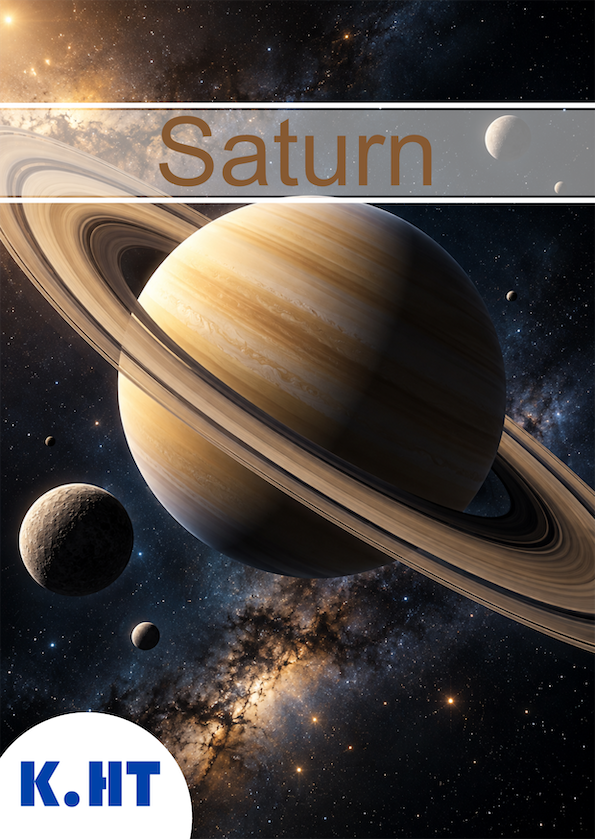
Saturn is one of the most impressive celestial bodies in our Solar System. Even through a small telescope, the sixth planet from the Sun looks extraordinary: a broad system of rings surrounds its golden, shimmering globe. Yet this famous sight conceals far more than a beautiful appearance. Saturn is a world of gas, clouds, storms and extreme physical conditions. This KHT pocket book offers an accessible, well-founded guide to the remarkable characteristics of the second-largest planet and explains why it has fascinated researchers for centuries. Anyone who spots Saturn in the sky sees only a tiny point of light. Scientific exploration turns that point into an entire world. The contrast between everyday observation and scientific discovery runs throughout the book. You will learn how our understanding of the planet has changed.
The book is intended for curious teenagers and adults who want to understand our Solar System better. Technical terms are explained in an easy-to-follow context. Step by step, readers gain a clear picture of what we know about Saturn, how that knowledge was obtained and which questions remain unanswered.
A Gas Giant with Surprising Properties
How large is Saturn compared with Earth? Why is its average density lower than that of water? And what does it mean to say that a gas planet has no solid surface? The chapters on Saturn’s structure explain its composition of hydrogen and helium, the extreme pressures deep inside it and the importance of metallic hydrogen. Its rapid rotation, unusually aligned magnetic field and internal heat are also described in an engaging, accessible way.
Another topic is Saturn’s weather. Tremendous winds, powerful storms and the mysterious hexagonal cloud formation at the north pole reveal just how dynamic its atmosphere is. Readers also discover why Saturn has seasons and why a single Saturnian year lasts almost thirty Earth years.
The Mystery of the Rings
Saturn’s famous rings take centre stage in several chapters. From a distance, they look like a continuous disc. In reality, they consist of countless particles, primarily water ice. The book explains how these particles orbit the planet, why some rings appear brighter than others and how the gravity of Saturn’s moons shapes them.
You will become familiar with the main ring regions, including the A, B and C rings and the Cassini Division. Equally fascinating is the question of their origin: did the rings form from the remains of a shattered moon, or through other processes? Their possible future is also explored. It becomes clear that Saturn’s rings are not a static ornament but a constantly changing system. Clear explanations show why the rings are astonishingly thin despite their enormous extent. Even apparently empty gaps still contain particles. Such details demonstrate the value of precise observations and reveal the surprising processes hidden behind a familiar view of the heavens.
Moons Full of Surprises
Saturn is surrounded by numerous moons with strikingly different landscapes and properties. The pocket book pays particular attention to Titan and Enceladus. Titan has a dense atmosphere and lakes of liquid methane and ethane. River channels, dunes and clouds make this alien world seem remarkably Earth-like in some respects, despite its extreme cold.
Enceladus, by contrast, astonishes us with immense jets of ice. Beneath its frozen surface lies an ocean of liquid water. The discovery of organic substances and other chemical clues makes it especially interesting for research into potentially habitable environments. Mimas, Rhea, Dione, Tethys and Iapetus also have their place: each moon contributes in its own way to the fascinating picture of the Saturn system.
Space Exploration, Discoveries and New Questions
How did we acquire our knowledge of Saturn? The book traces its exploration from the first telescopic observations through Pioneer and Voyager to the major Cassini mission. Particularly impressive is the story of the Huygens lander, which touched down on Titan in 2005 and transmitted images of an utterly alien landscape back to Earth.
The Cassini mission studied Saturn, its rings and its moons for many years before ending in 2017 with a controlled entry into the planet’s atmosphere. Its findings continue to shape research today. Finally, the book looks ahead: new missions, improved telescopes and unresolved scientific questions promise further discoveries. It distinguishes established findings from hypotheses that have yet to be confirmed. The missions described combine technological achievements with fundamental questions about nature. What can measurements from great distances reveal? Which observations provide evidence of oceans beneath ice? And why must space probes protect distant celestial bodies from contamination? These perspectives bring the history of discovery vividly to life.
Compact Knowledge to Take Anywhere
Across forty handy A6 pages, “Saturn – The Planet of Rings” offers a varied overview of one of the most remarkable planets. The short, clearly organised chapters are equally suitable for reading from beginning to end or consulting on a particular subject. From the planet’s formation to the future of its exploration, the book provides an accessible and coherent account.
Whether as an introduction to astronomy, a supplement to classroom learning or a short read for space enthusiasts, this KHT pocket book invites you to take a closer look. Discover the world of the rings, the secrets of the icy moons and the science behind one of the most beautiful sights in the night sky. It makes for an especially stimulating read.
About the book
- the eBook is immediately available as a PDF download (.zip file, 6.7 MB)
- 62 pages, Format A6
- 17 explaining graphics
- for teenagers
- for adults who need a quick overview about the topic

Reviews
There are no reviews yet.