
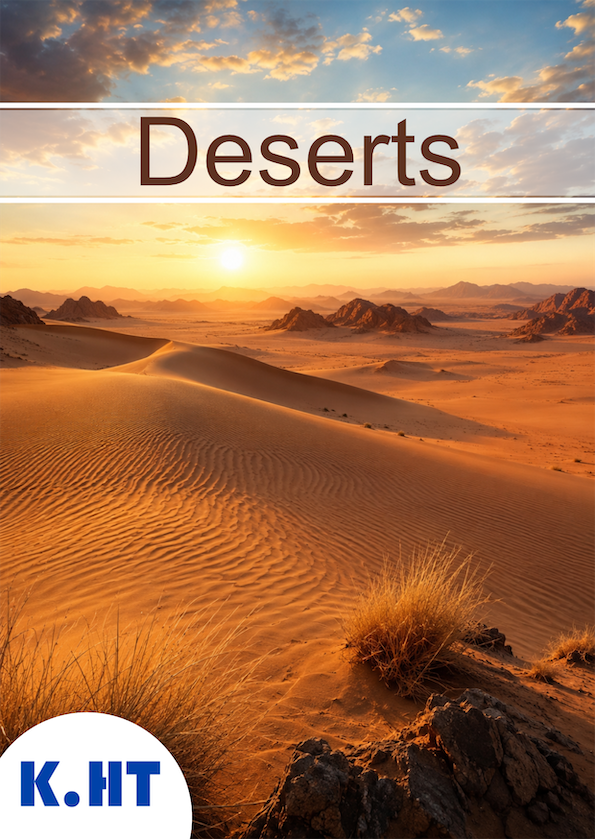
Endless dunes, scorching heat, mysterious oases and a sky stretching seemingly without limit above a barren landscape – deserts have always held a special fascination for us. They seem unfamiliar, mysterious and sometimes even hostile to life. Yet anyone who looks more closely discovers an astonishingly diverse world, full of life, movement and unexpected stories.
This book invites you on a varied journey through our planet’s deserts. It is about far more than sand and camels. A desert is much more than a landscape of golden dunes. There are hot and cold deserts, sandy, stony, rocky, gravel and salt deserts. One of the largest deserts on Earth is even covered predominantly in ice.
A World of Extremes
What exactly makes a desert a desert? How do these extraordinary landscapes form? Why does so little rain fall there? And how do plants and animals manage to survive in conditions that are often hostile to human life?
The book answers these and many other questions clearly and vividly. It explains how deserts develop, describes the different types of desert and shows how climate, mountains, ocean currents and air movements influence the dryness of a region.
One thing soon becomes clear: a desert is by no means an empty, motionless place. Wind shapes dunes, rare rainfall can rapidly turn dry riverbeds into raging torrents, and sand can be carried across enormous distances.
From the Sahara to Antarctica
A journey through the world’s deserts naturally includes the Sahara. The vast desert of North Africa is one of the best-known landscapes on our planet. Yet the deserts of the Arabian Peninsula, Australia, North America and Central Asia each have distinctive characteristics of their own.
A special chapter is devoted to the Atacama Desert in South America. It is among the driest regions on Earth and contains landscapes that sometimes seem to belong to another planet.
And then there is Antarctica. Ice, snow and temperatures far below freezing seem to be the very opposite of a desert. Nevertheless, because of its extremely low precipitation, Antarctica ranks among the largest deserts on Earth.
These examples vividly demonstrate just how different deserts can be.
Remarkable Survivors
Life in the desert is particularly fascinating. How can a plant survive for a long time without rain? Why are so many desert animals active at night? How do cacti store water? And why is a camel’s hump not a water tank?
The book introduces numerous survival strategies. Plants have deep or widely branching roots, store water or reduce evaporation. Animals avoid the greatest heat, live underground or obtain the moisture they need from their food.
The camel also receives a closer look. For thousands of years it has been closely connected with life in dry regions, and it possesses many physical adaptations that allow it to survive heat and drought.
It becomes clear that desert life is not simply a constant struggle for survival. It is a fascinating interaction among many species, each of which has found its own way of coping with extreme conditions.
Oases and People
Where water is available, the landscape changes. Oases form green islands amid arid regions and have been vitally important to people for thousands of years.
The book shows how people inhabit and use deserts. Nomadic ways of life, trade routes, camels, wells and traditional knowledge of water sources are explored alongside modern cities, roads, mineral extraction and solar energy.
It also raises an important question: how can dry regions be used without overburdening their fragile ecosystems and limited water resources?
Between Natural Resources and Climate Change
Deserts are not only fascinating natural environments. Valuable resources are sometimes found beneath their surface. Oil, natural gas, metals, salts and other minerals make certain deserts economically important.
At the same time, dry regions face major challenges. Water scarcity, intensive farming, overgrazing, resource extraction and changes in climate can place pressure on sensitive landscapes.
The book explains in accessible language what desertification means and how human land use and climatic changes can contribute to it.
Knowledge That Surprises
The journey concludes with fascinating desert records and ten astonishing facts. Did you know, for example, that desert dust can travel across oceans and even entire continents? Or that floods can occur in deserts despite their extreme dryness?
Such surprising information makes this book an engaging read for anyone eager to learn more about our planet.
For Everyone Who Wants to Discover the Earth
“Deserts – The Fascinating World of Earth’s Driest Landscapes” combines geographical knowledge, natural history, climate topics and intriguing facts into an entertaining and informative whole.
Whether the Sahara, the Atacama, the Australian deserts or Antarctica, every landscape tells its own story. Every plant and animal has developed remarkable strategies. And everywhere, we see how essential water is to life on our planet.
An informative and enjoyable non-fiction book for curious readers, nature enthusiasts, collectors of knowledge and anyone who wants to understand Earth’s fascinating landscapes better.
Step into a world of extremes – a world of sand and stone, heat and cold, wind and water, survival and adaptation.
Discover the desert anew.

Reviews
There are no reviews yet.